Quantum Error Correction: The Foundation of Reliable Quantum Computing
Introduction
Building a reliable classical computer is largely a solved engineering problem. Modern silicon transistors switch cleanly between high and low voltage states billions of times per second, and built-in hardware mechanisms automatically detect and repair rare bit flips in memory. Quantum computers face a radically different physical reality. Because quantum bits (qubits) rely on delicate quantum mechanical states—such as superconducting currents, trapped ions, or neutral atoms—even microscopic thermal fluctuations or stray electromagnetic fields can corrupt a calculation before it finishes.
For quantum computing to move beyond short experimental circuits toward sustained, industrial-scale computation, processors must overcome hardware fragility. That challenge makes quantum error correction (QEC) one of the most critical engineering frontiers in modern computing. Understanding how errors arise, how logical qubits protect information, and how cloud tools model noisy systems gives software engineers, architects, and IT leaders realistic insight into when and how fault-tolerant systems will emerge.
Common Sources of Errors in Quantum Systems
Unlike classical processors, where a 0 and 1 are separated by a wide voltage threshold, qubits operate in continuous complex vector spaces where tiny disturbances alter state amplitudes and phases.
| Error Source | Physical Mechanism | Impact on Quantum Computation |
| Decoherence (Relaxation & Dephasing) | Unwanted interaction between qubits and their surrounding thermal or electromagnetic environment. | Superposition states decay toward classical ground states (T1 relaxation) or lose relative phase information (T2 dephasing) over microseconds or milliseconds. |
| Gate Errors | Imperfections in the microwave pulses, laser beams, or magnetic fields used to execute quantum gates. | Qubit rotations overshoot or undershoot target angles; two-qubit entangling gates (CNOT) typically introduce higher error rates than single-qubit gates. |
| Readout (Measurement) Errors | Inaccuracies when translating a collapsed quantum state into a classical 0 or 1 signal. | A qubit physically in state ` |
| Crosstalk & Leakage | Operations applied to one qubit inadvertently disturb neighboring qubits or push a qubit outside its computational basis states. | Correlated errors spread across adjacent qubits, complicating circuit transpilation and error mitigation. |
Why Classical Repetition Does Not Work
In classical networking and storage, protecting a bit is straightforward: copy 0 into 000, transmit all three copies, and use majority voting at the receiver. If one bit flips to 010, the system reads the two remaining 0s and restores the original value.
Quantum mechanics forbids this direct approach for three reasons:
- The No-Cloning Theorem: It is physically impossible to create an identical copy of an arbitrary unknown quantum state.
- Measurement Collapse: Directly inspecting a qubit to check whether an error occurred collapses its superposition, destroying the quantum information mid-calculation.
- Continuous Error Types: Classical bits only suffer bit flips (
0↔1). Qubits can experience bit flips, phase flips (changing the sign between|0⟩and|1⟩), or arbitrary small rotational shifts.
Core Principles of Quantum Error Correction and Logical Qubits
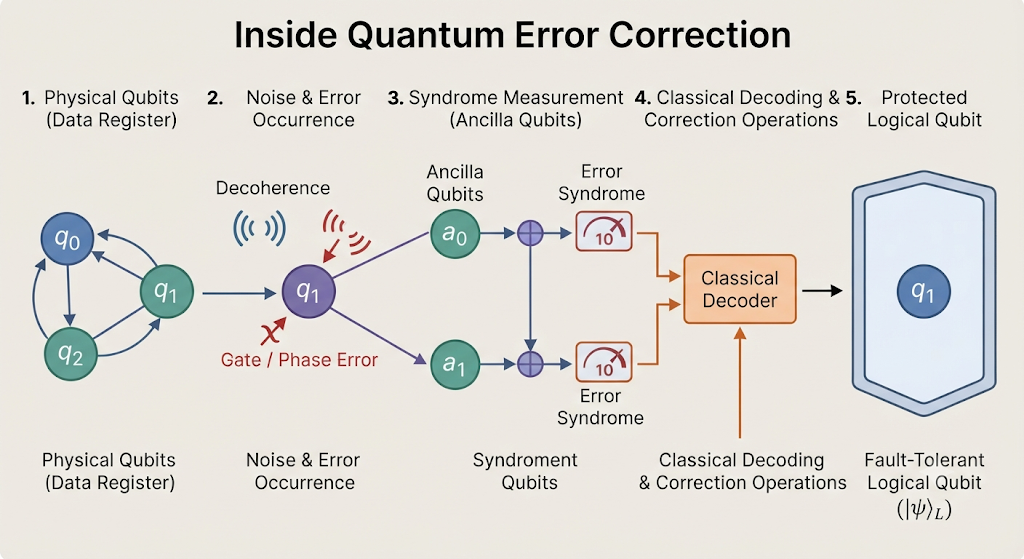
Quantum error correction bypasses these restrictions by encoding the information of a single logical qubit across an entangled network of many physical qubits. Rather than copying the quantum state, QEC spreads quantum information non-locally so that no single physical qubit holds the complete state.
To detect errors without collapsing the encoded data, QEC relies on ancilla (helper) qubits and syndrome measurement:
- Parity Checks: Ancilla qubits interact with groups of data qubits to check parity relationships (for example, whether two neighboring qubits share the same state) without revealing the individual qubit values.
- Syndrome Extraction: Measuring only the ancilla qubits yields an “error syndrome”—a classical diagnostic signature indicating whether a bit flip or phase flip occurred and which physical qubit was affected.
- Recovery Operations: Based on the syndrome readout, classical control electronics apply targeted corrective Pauli gates (
XorZ) to restore the logical state while leaving the underlying superposition intact.
Codes such as the surface code arrange physical qubits in a two-dimensional grid, allowing local nearest-neighbor parity checks that suppress logical error rates as long as physical gate errors remain below a critical threshold.
Circuit Design, Hardware, and Fault-Tolerant Computing
Running error correction continuously during a computation defines fault-tolerant quantum computing. In a fault-tolerant architecture, logical gates are executed directly on encoded logical qubits so that a single hardware fault cannot cascade uncontrollably through the circuit.
This architecture links hardware design and software compilation tightly together. Physical chip topology dictates which QEC codes can be mapped efficiently without excessive SWAP gates, while real-time classical decoders must process syndrome measurements within microseconds to keep pace with gate execution. Because full fault tolerance requires substantial qubit scale, near-term systems rely on hybrid quantum classical computing training patterns—combining shallow quantum circuits and post-processing error mitigation with classical optimization loops.
Current Challenges: Overhead, Scalability, and Resources
While recent laboratory milestones have demonstrated logical qubits outperforming individual physical qubits in controlled experiments, scaling fault-tolerant systems presents major engineering hurdles:
- Hardware Overhead: Depending on physical error rates and target algorithm depth, encoding a single reliable logical qubit can require hundreds or even thousands of physical qubits.
- Real-Time Classical Decoding: Syndrome extraction generates high-bandwidth classical data streams that must be decoded instantaneously by classical FPGAs or ASICs before qubits decohere.
- Cryogenic and Control Scaling: Wiring, cooling, and calibrating millions of physical qubits without introducing thermal noise or crosstalk remains an active hardware engineering challenge.
Separating these ongoing engineering requirements from current noisy intermediate-scale quantum (NISQ) capabilities helps technology teams maintain realistic expectations around commercial timelines.
Exploring Quantum Error Correction with Cloud Tools and Simulators
Developers and architects do not need physical fault-tolerant processors to study noise models and error correction circuits. Open-source frameworks and cloud platforms provide accessible sandboxes for hands-on experimentation:
- Qiskit: Allows developers to construct repetition codes, attach custom device noise models, and run density-matrix simulations via Qiskit Aer. Enrolling in a structured Qiskit programming course helps engineers understand how transpilation and hardware noise affect circuit depth.
- Cirq: Offers built-in noise channels (such as depolarizing and bit-flip channels) and stim-compatible tools for simulating stabilizer circuits and surface code syndromes at scale.
- IBM Quantum and AWS Braket: Expose real superconducting, trapped-ion, and neutral-atom Quantum Processing Units (QPUs) alongside managed simulators. Practicing through quantum cloud computing training and AWS Braket training enables teams to benchmark ideal simulator outputs against physical QPU noise profiles.
A Practical Learning Roadmap for IT Professionals
Technology professionals can build practical fluency in quantum reliability and architecture systematically:
- Strengthen Foundations: Review Python, basic linear algebra, and probabilistic measurement principles.
- Simulate Noisy Circuits: Build a basic three-qubit bit-flip repetition circuit in Qiskit or Cirq and test how depolarizing noise alters bitstring histograms.
- Compare Simulators and Cloud QPUs: Run identical circuits on local simulators and cloud backends via IBM Quantum or AWS Braket to observe real decoherence and readout errors.
- Study Architectural Trade-Offs: Explore how physical qubit overhead, classical decoders, and hybrid classical-quantum orchestration impact system design.
Different roles benefit from tailored focus areas: developers build circuit-level fluency through quantum computing for software engineers curricula, cloud and systems designers evaluate hardware topologies via a quantum computing architecture course, and technology leaders align R&D budgets with realistic milestones through quantum computing for IT managers programs.
For professionals seeking guided structure, QuantumOps School serves as an India-based quantum computing education, certification, and consulting platform. Its advertised learning tracks—covering Architect, Engineer, Manager, and Professional pathways—combine instructor-led sessions, practical labs, circuit simulations, case studies, technical assessments, and capstone projects. Completing a structured quantum computing certification course or earning a provider-issued QuantumOps certification helps validate practical familiarity with quantum workflows, while organizations evaluating architectural readiness or workforce enablement can engage quantum computing consulting services for tailored technical guidance.
Frequently Asked Questions
Why can’t quantum computers simply copy qubits like classical backup bits? The no-cloning theorem in quantum mechanics proves that an arbitrary unknown quantum state cannot be copied identically, and directly measuring a qubit collapses its superposition. Quantum error correction instead entangles multiple physical qubits and uses helper ancilla qubits to detect errors indirectly.
What is the difference between error mitigation and quantum error correction? Error mitigation uses classical post-processing and circuit-level techniques on noisy near-term processors to reduce bias in expectation values without extra logical qubit encoding. Quantum error correction encodes logical qubits across many physical qubits to actively detect and fix errors in real time, enabling fault-tolerant scaling.
Can software developers experiment with quantum error correction today? Yes. Developers can use Python frameworks such as Qiskit and Cirq to build basic bit-flip and phase-flip repetition codes, inject simulated noise models, and observe syndrome measurement outcomes on classical simulators.
Conclusion
Quantum error correction bridges the gap between fragile physical qubits and dependable, large-scale quantum computation. By understanding how decoherence and gate errors arise, how syndrome measurements protect logical qubits without collapsing superposition, and how simulators model noise today, IT professionals can evaluate quantum hardware progress with clarity and technical rigor.
Leave a Reply